domenica 4 novembre 2012

MOBILIciTY-Tirana Multimodal Station // THIRD PRIZE - CRETTO -Massimiliano Savino, Andrea Baresi, Davide Ravasio - ITALY


Design concept
CRETTO is the new Tirana station, a layered machine consisting of urban and natural paths, which defines new interstitial spaces, canyon, different size and altitude squares. The barycentre develops a huge space at the borderline between urbanized and natural from which two towers stands and on which the five teeth that
are CRETTO look.
A functional aggregation laboratory mixing receptive, commercial and directional functions together with a
fully-­‐developed mobility system: Mobilicity is linked to the center and the northern of Tirane, to the airport and Duress by railway lines, tram, road, bike and pedestrian lanes.
Mobilicity offers parkingareas, car and bike sharing and thus it plays in a contemporary way the role of a modern city central station.

Diagram analysis
Starting from the early twentieth century, Tirane has been affected by an increasingly urban rising. The so called urban sprawl condemned the city to green areas reduction and excessive country consumption creating a dependence on cars due to the higher distance from facilities,
work and public transportations. Overall, the urban sprawl was enhanced by the lack of infrastructures, alternative mobility as bike lanes, car sharing services, sidewalks or properly interconnected crosswalks.
This was leaving the city at the mercy of an uncontrolled settlement saturation.
Once aware of the emergency, the public administration hardly tried to face the problem patching the urban tissue: the attempt to deal with the different issues all over the city started in
primis from the northern area. Among all the consulted experts, the Grimshaw Architects studio won the first prize, thanks to the design of new interconnections between the urban center and the Pasqukan park together with the project of a deep green area east bounded with the newborn railway station.
This is the vision of the project. The park designed by Grimshaw Architects hardly creeps into  the project area breaking the station nucleus into five teeth, which represent the new urban station.
This is not a unique buildings living the rupture between the façade of the city center and the binaries one; it is a complex organism able to address the different flows coming from the outback and always interacting with the green ipogea square which takes inside the power to hold and spread different functions. Starting point of the project is the reorganization of both the infrastructure and the transport system.
Through a south-­‐east traffic roundabout, in which SH2 and E762 converge, the traffic from the
hinterland to the city center has been filtered. 


Functional Diagram
The project also provides two huge parks and ride areas underling the intermodal hub project vision: the idea is to avoid the access to the city center with its own car to stimulate the use of alternative mobility methods such as bike-­‐car sharing and tram. Concerning the railway line, the designed station is a terminus station that is turned into a pedestrian and tram path moving from the project area to the city center.


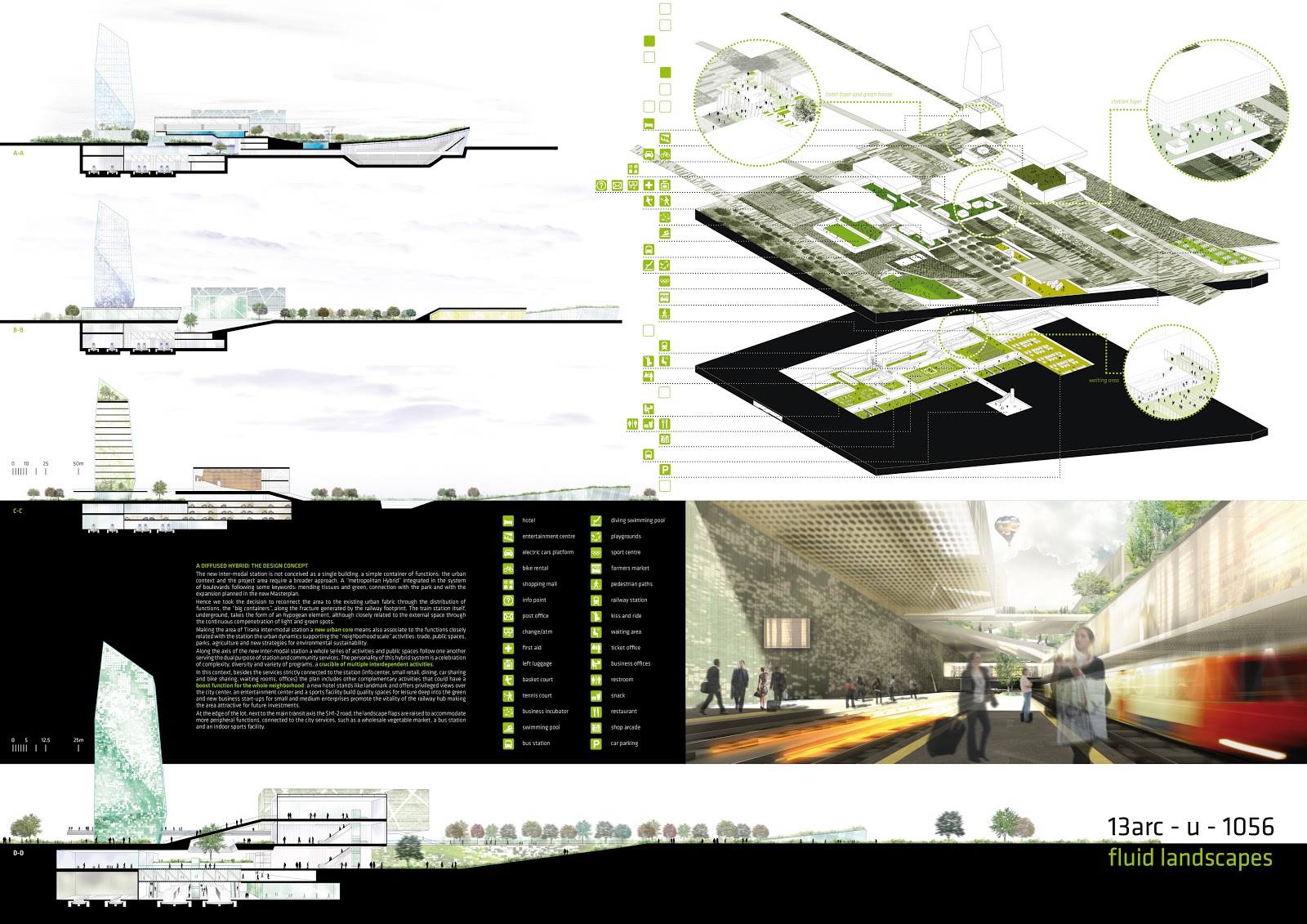
MOBILIciTY-Tirana Multimodal Station // SECOND PRIZE - FLUID LANSCAPES - MORFÈ_ARCHITETTURA, ITALY


FLUID LANSCAPES: TIRANA MULTIMODAL STATION

The Masterplan for Tirana new Multimodal station is not only a project of a railway station: it is a project about Tirana. The chaotic and informal feature of the city asks for the tracking of a simple and clear sign that would restore order and a hierarchy between the urban parts.
The  purpose of the Masterplan consists in giving back an identity to the area. The new station becomes a urban gesture: transport flows insinuate themselves into the ground and give rise to an earthquake, a landscape rises up and generates space and connections while supporting (conceptually and physically) new features.


The railway footprint becomes a urban axis, a canyon on which stood, at different levels, all functions of the Masterplan: a whole series of activities and public spaces follow one another serving the dual purpose of station and community services. The personality of this hybrid system is a celebration of complexity, diversity and variety of programs, a crucible of multiple interdependent activities.
The landscape determines the project: the pace of green stripes reinterprets agricultural practices and techniques, creating a system of green spaces and “thematic rooms” (squares, sports facilities, playgrounds) that answer to the spatial and ecological deficiency of the urban periphery.


The new inter-modal station is not conceived as a single building: functions, are distributed in big containers” along the fracture generated by the railway footprint. The train station itself, underground, takes the form of an hypogean element, although closely related to the external space through the continuous compenetration of light and green spots.


MOBILIciTY-Tirana Multimodal Station // FIRST PRIZE - Alda Çapi Black and Chris Masicampo, U.S.A.


Charged with establishing easier connections to the main activities and services in the heart of the city of Tirana, the proposal is a hybrid design that combines a transportation center with recreational facilities. It allows commuters to navigate fluidly among different modes of transportation - light rail, commuter rail, buses, cars and bicycles - and offers opportunities for people to shop, eat, work and play.
The site, at a distance from the city center, incorporates a hotel and office tower and many community amenities: event venues, park, soccer field, tennis courts, swimming pools, and cafes. A retail spine unifies the diverse program and creates transitional space between horizontal and vertical. Undulating bands modulate natural light, and the tower contributes density as well as iconography. In keeping with the scale of the city, the design creates a commuter and communal hub resonant with the future development of Tirana.


venerdì 13 aprile 2012

LIFE SAVING // THIRD PRIZE - The RESCUE NETWORK - MHD, France


The rescue network


The rescue network is a global way of thinking the reconstruction of cities or the adaptation of the spared ones. Because of the speed of the phenomenon and the lack of anticipation, rescue means proximity to the inhabitant. With this kind of wide territory disaster resilience is a strength of the system. The rescue network integrates these three key features.

“I ran away after I heard a tsunami was coming,” told Jiji Press. “But I turned back to fetch something from home and was swept away. I was rescued while hanging on to the roof of my house.”

Network city is based on distributed tall shelter that can only exist as part of the full master plan of the city. This new kind of urban vegetation settles on common urban objects: house, shops or street lights. The mesh of the grid is about 200 meters wide.

The rescue network brings a new visual identity to the coast cities, warning the people about the tsunami danger in the area.

Pictures are a sad proof of the devastating power of tsunami. But in these pictures lies the solution to protect the city of tomorrow. Where any human artifact seems to be able to resist to the wave, natural constructions often look much more resilient. Rescue network dives into trees roots to settle it solution.

Inspired by the trees roots, the basement of the pylon is wide rhizome made of steel. These roots divide the force of the wave and avoid the tree to be toppled.

Rhizomes connected together form a resilient network for energy, water and communication in the city.

Communication empowers the efficiency of the rescue organization. Fresh water is the fuel for life to settle again. Energy gives the first spark of hope after the darkness of disaster.


 www.awrcompetitions.com

mercoledì 21 marzo 2012

SECOND PRIZE LIFE SAVING - First Step Against Disaster // SAKURA - Alec Singh, Germany

SAKURA is a design concept for living in coastal regions and how to face the huge desastrous impact of a tsunami for peoples life. The idea is based on accepting the power of nature and not to confront it with a larger „hight-tech seawall“. The main problem is our way of life and the limited ability to adapt to certain circumstances: If there were no settlements near the coast, a tsunami just wouldn‘t be a problem. In the same way the tsunami is little to no threat for e.g. a seagull. There must be an emergent solution for us if we recognize what the real desaster is.
The events in Japan one year ago brought up a lot of information and video footage about the disaster. The attached video (link: youtube-video1) captured by the japanese coastguard shows us two vital pieces of information:
1. The size of a tsunami wave depends on its distance to the coast.
2. A ship would intentionaly head towards the wave to minimize the risk of capsize.
So running away could be much morehazardous than looking for a safe way of confrontation.
With this information a simple design is possible. SAKURA suggest a settlement of houseboats near the coast. The houses are connected to an early warning system and are capable of navigating on the sea from their own power, at least for a short period of time (e.g. jetski-engines could be used). If an seaquake is recognized, the SAKURA-houses immediatly leave their moorings and try to bring as much distance to the coast as possible by heading towards the open sea. In this way, the can withstand both, earthquake and tsunami.

Descriptions
[ HOUSEBOAT ] - The SAKURA houseboat is a very compact designed place to live.
[ SAKURA-DOCK ] - Five houseboats are combined together to offer easier access. They are being held in place until a seaquake occurs.
[ SEAQUAKE ] - Docks can be combined to build larger settlements and structures. This way of organization makes it easier to recover the houseboats after the tsunami.
[ TSUNAMI ] - The early warning system detected the seaquake and gave a signal for launching the SAKURA houseboats. They are heading towards the wave.

www.awrcompetition.com

sabato 17 marzo 2012

LIFE SAVING // FIRST PRIZE - KOGAMI - Komunitas Siaga Tsunami - Ben Devereau, United Kingdom


Water supports life in all its many forms, but its power to create is equalled at times by its power to destroy. Tsunami can overwhelm even the most enormous of civil engineered defences, and due to their great expense much of the world’s vulnerable coastline communities do not even have the benefit of these.

The catastrophe of the 2011 Japanese Tsunami revealed that even massive civil engineering projects could prove impotent against such powerful natural events redoubled the intent to research other possibly more effective strategies which might grow out of natural systems, operating on the basis of an incremental decrease in incident wave power over the simple expedient of building massive walls.
This proposal attempts to provide an effective strategy of tsunami amelioration, which also supports the diminishing warm water reef ecosystems, and which provides the very materials that might be required to construct economically affordable and effective refuges for the vulnerable coastal communities without the economic resources to construct traditional defences.
The prototype scheme is situated in the Sumatran City of Padang, where the occurrence of a massive tsunami is sadly a question of when, and not if.

The project explores the developing technology of cathode accretion, a process in which calcium carbonate suspended in seawater is continuously accreted onto ferrous skeleton forms in the presence of very low electrical charge.

It is proposed to utilise this technology in two separate but connected systems; the construction of new and robust warm water coral reefs to enhance the local economy and reduce the power of waves approaching the coast; and the ‘growing’ of a system of construction elements that might be assembled into coastal structures which would operate as everyday community hubs, but which would also have a structural profile making them uniquely resistant to the damage a tsunami would cause other building typologies.
Using forms derived from naturally robust ecologies, principally mangrove forests and warm water corals, as well as drawing on the effective vernacular strategies developed over the centuries to modify the environment for human comfort, the new typology is designed to be locally designed, manufactured, assembled and maintained.

The project can be characterised as development of new technologies suited to their environmental and social context, and not the uneconomical imposition of high technology. It is from these premises that the manifesto of key drivers came to be defined that directed the development of this scheme.
In Padang, significant resources have been directed toward preparing for tsunami. One local organisation involved is Kogami, the “Komunitas Siaga Tsunami Alert Community”. Presently working on a tiny budget, Kogami focus on education and drills for the local population. It has been central to this proposal that their invaluable work is embedded throughout the scheme to provide the coastal population with the best possible chance of survival when the tsunami eventually occurs.

www.awrcompetitions.com 

domenica 26 febbraio 2012

Kengo Kuma’s Idiosyncratic Starbucks Store Opens

Kengo Kuma and Associates

The ubiquity of the Starbucks brand has yielded an unsurprising aesthetic monotony among their ever-expanding empire of coffee shops. The anatomy of nearly every Starbucks store can be reduced to the same basic elements, from the mood lighting and tacky factory art to the Michael Buble (or Jacques Brel, vintage post-war Franco ephemera are always a sure bet) records blaring over the tinny speaker system. While the level of customization of drink orders is relatively broad, the custom Starbucks shop is essentially an anomaly. In the case of Kengo Kuma‘s new Starbucks cafe in Fukuoka, Japan, that is a good thing. The new store is both ornate and minimal, traditional and modern, continuing the architect’s exploration in the crafts and carpentry heritage of his native land. 
The Kuma Starbucks is located adjacent to the grounds of the Dazaifu Tenmagu, a Shinto shrine complex of several wooden structures set within a park-like environment of trees, ponds, and courtyards. The store’s design was meant to evoke the shrine’s tranquil atmosphere, with such features as an inner garden planted with plum trees and an interior wooden frame stretching the full-length of the shop meant to reference the ceremonial lumber structures nearby.
Kengo Kuma and Associates

Kengo Kuma and Associates

Kengo Kuma and Associates

For the frame, which recalls the architect’s career-long idiosyncratic use of wood, Kuma has created a three-dimensional matrix of angled 6cm square blocks which overlap each other, resembling some viral, organic growth which spreads from the sidewall to the ceiling, neatly siphoned off at the storefront edge. This was the intention, says the architect, who wanted the store to be contextually rooted in the site, as if almost “nested” within it. Kuma has also suggested that the wood blocks were recycable, saying that “You can dismantle the building and reassemble it somewhere else.” 
Kengo Kuma and Associates

Kengo Kuma and Associates


mercoledì 22 febbraio 2012

ADA 2011 - Architecture Dissertation Award // TURBULENS - Wolfgang Mitterer, Italy

Turbulens - Freetøwn Windfløw Eksperiment


In the heart of Copenhagen exists another world: Christiania. This part of the city is different in many ways – it is a place with other rules and other possibilities: the residents decided to break with the rules of society and to create their own values – it is one of the most fundamental issues to understand this social experiment. Christiania is open for new ideas, also in the field of sustainability: In 2010, the inhabitants organized the "bottom meeting", Christiania's response to the UN climate conference in December 2009. The bottom meeting dealt specifically with renewable energy sources and their relations with architecture for Christiania.


In conversation with former Christiania resident and architect Mette Prague it became clear that one of the greatest desires of the inhabitants is the independence from Copenhagen. This desire has existed since the founding years of the Free State.


Liberty and autonomy also means independence from all energy supplies coming from the city of Copenhagen. Mette also explained about a successful experiment of a hippie colonie that, in the seventies, with the construction of a wind power plant has developed one of the largest and most modern facilities of that time. This inquiring mindset is still deeply rooted in the residents of Christiania. They prefer to invest their money in the development of wind power plants instead of entrusting bank institutions with their wealth.
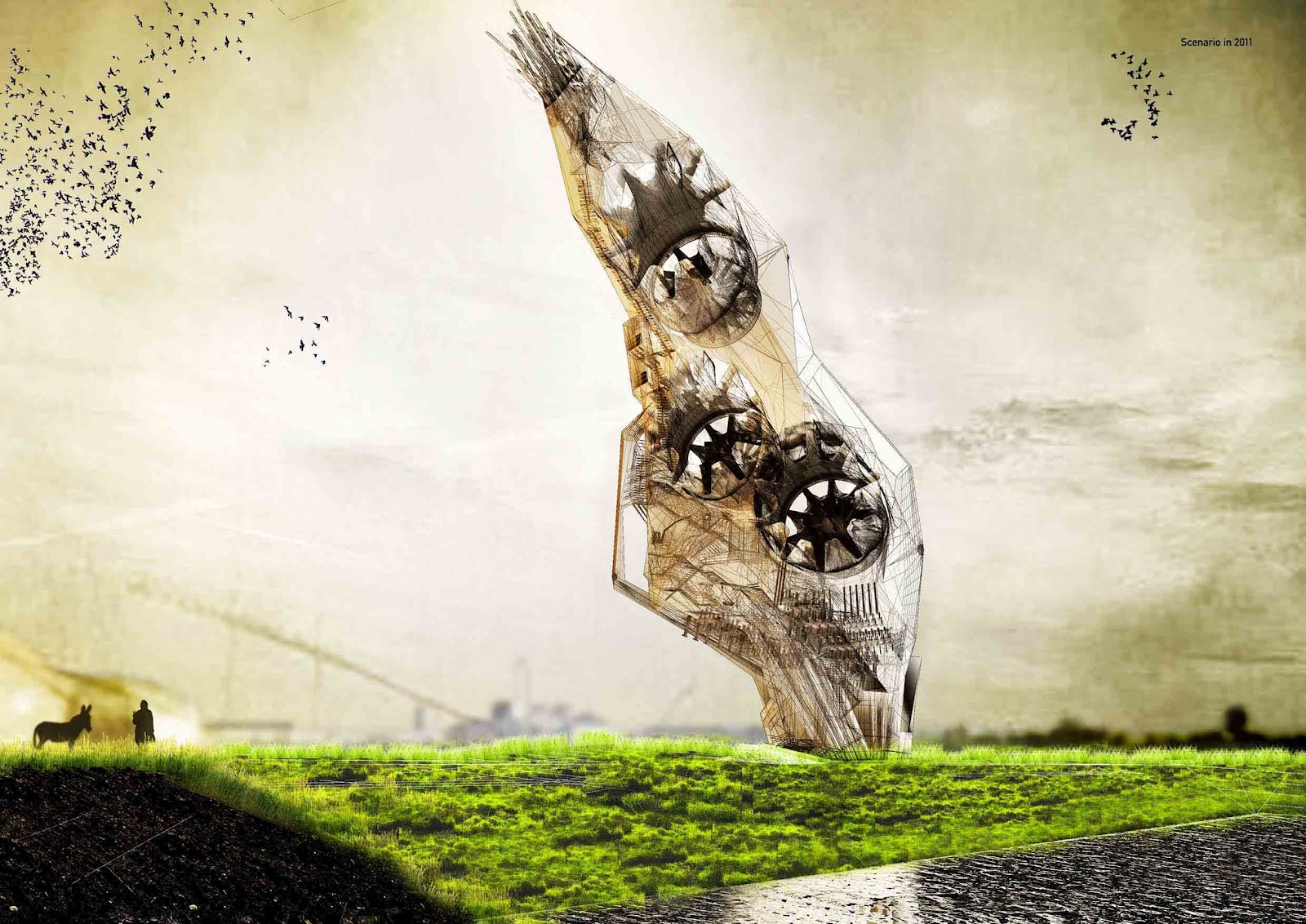
For this reason, I designed a power plant for Christiania, which uses wind power to give the Free State an independent power supply. The research and the use of natural resources are the two most important pillars set in my design.

CONCEPT:
In this area of Copenhagen the main wind direction is north or northeast. The wind power can be optimally used if the turbines are placed above building height. The existing buildings would slow down its speed, but not the wind that arrives from the channel to the building site. Through the protection wall the wind gets a boost, the currents get stirred up. This provides the framework for my design process. In a model study, I simulate exactly this situation. I glue paper to the building site and with a hair dryer I simulate the wind. The moment the paper hits the dam, it gets hurled into the air and then rearranged. I recorded this situation. In the analysis, I took a picture every 15 seconds to overlay those snapshots. Finally, I got a single image used as inspiration for the design process.
The project is mainly divided into 3 sub-functions:
- the production of electricity by wind for the power supply of Christiania
- a research centre: the development of new concepts for the production of electricity
- greenhouse: the use of natural resources (water and wind) for food production
About 30 years ago such visions have already been researched and developed, this spirit should also be part of Christiania’s future: with my project I deliver the architecture and infrastructure fulfilling this need.


lunedì 20 febbraio 2012

ADA 2011 - Architecture Dissertation Award // FORESTICITY - Dimitris Anagnostopoulos, Hui ju Lee, Greece-USA


In the past, Ethiopia was known for its wealth of natural resources; however, this situation changed during the last century as huge tracts of land were claimed for agricultural use. Severe soil erosion and degradation reduced the fertility of the land, lessening agricultural productivity. Deforestation has had a major impact on both the country’s ecology and its economy. Ethiopia’s economic backbone is its agricultural potential, so measures for reversing deforestation need to regain as much fertile land as possible. Confronted with this condition, we propose Foresticity, a project that uses reforestation as an urban design strategy for Ethiopia. This proposal for a new settlement provides benefits not only for the inhabitants, but also for the entire ecological system. When reforestation occurs in conjunction with the expansion or generation of cities, the growth of those cities acts as a tool for forest regeneration. Ultimately, cities become a means to spread forests throughout the country.


The first step of implementing the new settlement is to establish a tree nursery near the center of the city in order to produce and distribute seedlings, as well as to transmit knowledge. This nursery acts as the first educational center for generating the city. After about one year, seedlings from the nursery will be planted on a hill surrounded by a fence, near churches and mosques, and inside living compounds. With support from NGOs, local kebele will be responsible for the reforested areas which will be protected from exploitation. The reforested hill will protect water resources, stabilize the soil, and prevent erosion, so that water flowing down the hill will be clean and dams at the bottom will not be filled with sludge. Additionally, the trees will prevent soil from being washed into the lower farmlands and damaging crops. Trees that are located within the compound of a church or mosque are traditionally protected, thus making these places good sites for initial planting. Trees inside living compounds are protected as private property by each household, providing them with multiple benefits, such as fruit, fodder, construction materials, and modified microclimates.

A university specializing in forestation is the second element to be established. It will further research and environmental monitoring. Simultaneously, trees will be planted on farm and grazing lands for intercropping. By implementing the principles of agroforestry, trees will deliberately be integrated into fields with crops and animals in order to maximize the use of the land, thus creating both ecological and economic benefits. The recommended tree species are those with certain characteristics that are native to, or widespread in, Ethiopian natural forests. Leguminous species, for example, are recommended for intercropping because these trees aid in nitrogen fixation and do not compete with the crops.  Albizia gummifera and Cordia africana are appropriate tree species for shading and producing better quality coffee.

A piece of land is to be reserved for wood harvesting, thus establishing light industry. Fast-growing and frequently-used tree species are recommended to provide fuel wood, charcoal, and timber for construction use, which can begin to be harvested in five to ten years. Within twenty years, better quality timber and crops will be produced, further increasing employment opportunities. The land is optimized and productivity increases. Additionally, the natural forest started on the hill will have progressed enough for diverse wildlife to return. Open spaces for public activities are established, thereby modifying the surrounding microclimate. Both the city and the forest will have grown to produce an interdependent urban environment.

Cities can benefit both economically and ecologically from reforestation. Trees provide energy resources and construction materials, increasing income for the settlement. Intercropping improves the quantity and quality of agricultural products. The benefits provided by reforestation are much greater than typically perceived and function as an essential generator for a sustainable, resilient city and environment. By combining the reforestation process with the development of a city, a critical symbiotic relationship is produced where each can benefit from the other and excel.